

Over 60 percent of tomorrow’s fastest-growing jobs will demand strong science and math skills. For parents and educators, building this foundation early is more crucial than ever. STEM toys turn complicated ideas into hands-on discoveries that spark a lasting love for learning. Discover how these unique playthings fuel curiosity, develop problem-solving abilities, and prepare children for a bright future in a world shaped by technology.
Table of Contents
- What Are STEM Toys and Why They Matter
- Different Types of STEM Toys Explained
- Developmental Benefits for Children
- Choosing Age-Appropriate STEM Toys
- Common Pitfalls and Safety Guidelines
Key Takeaways
| Point | Details |
|---|---|
| Importance of STEM Toys | STEM toys are crucial for introducing children to foundational scientific and mathematical concepts through engaging, hands-on play. |
| Developmental Benefits | These toys enhance cognitive skills, emotional resilience, and social collaboration, laying the groundwork for lifelong learning. |
| Age Appropriateness | Selecting age-appropriate STEM toys ensures that they match children’s cognitive development and current interests, maximizing engagement and learning. |
| Safety Considerations | Parents must prioritize safety by checking age recommendations and supervising interactions with electronic and complex toys to prevent potential hazards. |
What Are STEM Toys and Why They Matter
STEM toys represent a powerful educational tool designed to introduce children to Science, Technology, Engineering, and Mathematics through engaging, interactive play. These carefully crafted learning resources transform complex concepts into playful experiences that spark curiosity and develop critical thinking skills from an early age.
At their core, STEM toys are more than just playthings. They are purposefully designed learning instruments that encourage children to explore, experiment, and understand foundational scientific and mathematical principles through hands-on interaction. Whether it’s a robotic building set, a microscope kit, or a coding board game, these toys provide immersive experiences that make learning feel like an adventure rather than a chore.
Understanding the significance of STEM toys requires recognizing how they support cognitive development. These toys help children develop essential skills such as problem-solving, logical reasoning, spatial awareness, and analytical thinking. By presenting challenges in a fun, interactive format, STEM toys transform learning from a passive to an active process. Children aren’t just absorbing information; they’re constructing knowledge through direct manipulation and exploration.
Key benefits of STEM toys include:
- Encouraging scientific curiosity
- Developing critical problem-solving skills
- Introducing complex concepts through play
- Building confidence in mathematical and technological domains
- Preparing children for future academic and professional challenges
For parents seeking to support their child’s educational journey, Understanding Why Choose Educational Toys provides deeper insights into selecting the right developmental resources that nurture learning and growth.
Different Types of STEM Toys Explained
STEM toys come in diverse categories, each designed to engage children with unique learning opportunities across scientific and technological domains. These carefully curated educational tools help transform complex concepts into accessible, enjoyable experiences that spark curiosity and promote interactive learning.
One primary category is Construction and Engineering Toys, which include building sets, robotics kits, and engineering challenges. These toys encourage spatial reasoning, problem-solving, and mechanical understanding. Lego sets, mechanical engineering blocks, and programmable robot kits fall into this category, allowing children to design, construct, and experiment with three-dimensional structures and mechanical systems.
Another significant category encompasses Scientific Exploration Toys. These include microscope sets, chemistry experiment kits, geology collections, and nature exploration tools. Such toys invite children to observe, investigate, and understand natural phenomena through hands-on scientific methods. From examining tiny organisms under a microscope to conducting safe chemical reactions, these toys transform scientific learning into an exciting discovery process.

Digital and coding-based STEM toys represent a cutting-edge category that introduces children to technological literacy. Coding Toys like programmable board games, digital design platforms, and simple coding kits help children understand computational thinking and basic programming concepts. These toys demystify technology, showing children that coding isn’t just for experts but can be a creative and enjoyable activity.
Key STEM toy categories include:
- Construction and Engineering Sets
- Scientific Exploration Kits
- Coding and Programming Toys
- Mathematical Reasoning Games
- Electronic and Circuit Building Sets
To explore more about educational toy selections that support developmental learning, 6 Types of Educational Toys to Boost Learning Fun provides comprehensive insights into choosing the right resources for children’s growth and engagement.
Developmental Benefits for Children
STEM toys play a crucial role in children’s cognitive, social, and emotional development, offering far more than simple entertainment. These innovative learning tools are designed to nurture critical skills that form the foundation of lifelong learning and personal growth across multiple developmental domains.
In the realm of cognitive development, STEM toys stimulate intellectual growth by challenging children to think analytically, solve problems, and develop complex reasoning skills. These toys encourage children to approach challenges systematically, breaking down complex problems into manageable steps. Through building, experimenting, and exploring, children learn to think critically, make predictions, test hypotheses, and draw meaningful conclusions - skills that are essential in academic and professional settings.
Beyond cognitive skills, STEM toys significantly contribute to emotional and social development. By engaging with these toys, children learn patience, persistence, and resilience. Collaborative STEM activities teach teamwork, communication, and the importance of sharing ideas. When children work through challenging tasks, they build self-confidence, learn to manage frustration, and develop a growth mindset that views challenges as opportunities for learning rather than obstacles.
Key developmental benefits include:
- Enhanced problem-solving capabilities
- Improved spatial and logical reasoning
- Increased creativity and innovative thinking
- Better communication and collaboration skills
- Stronger mathematical and scientific foundations
- Improved fine and gross motor skill development
To understand more about how play contributes to children’s growth, Complete Guide to the Role of Toys in Development offers comprehensive insights into the transformative power of educational play in childhood development.
Choosing Age-Appropriate STEM Toys
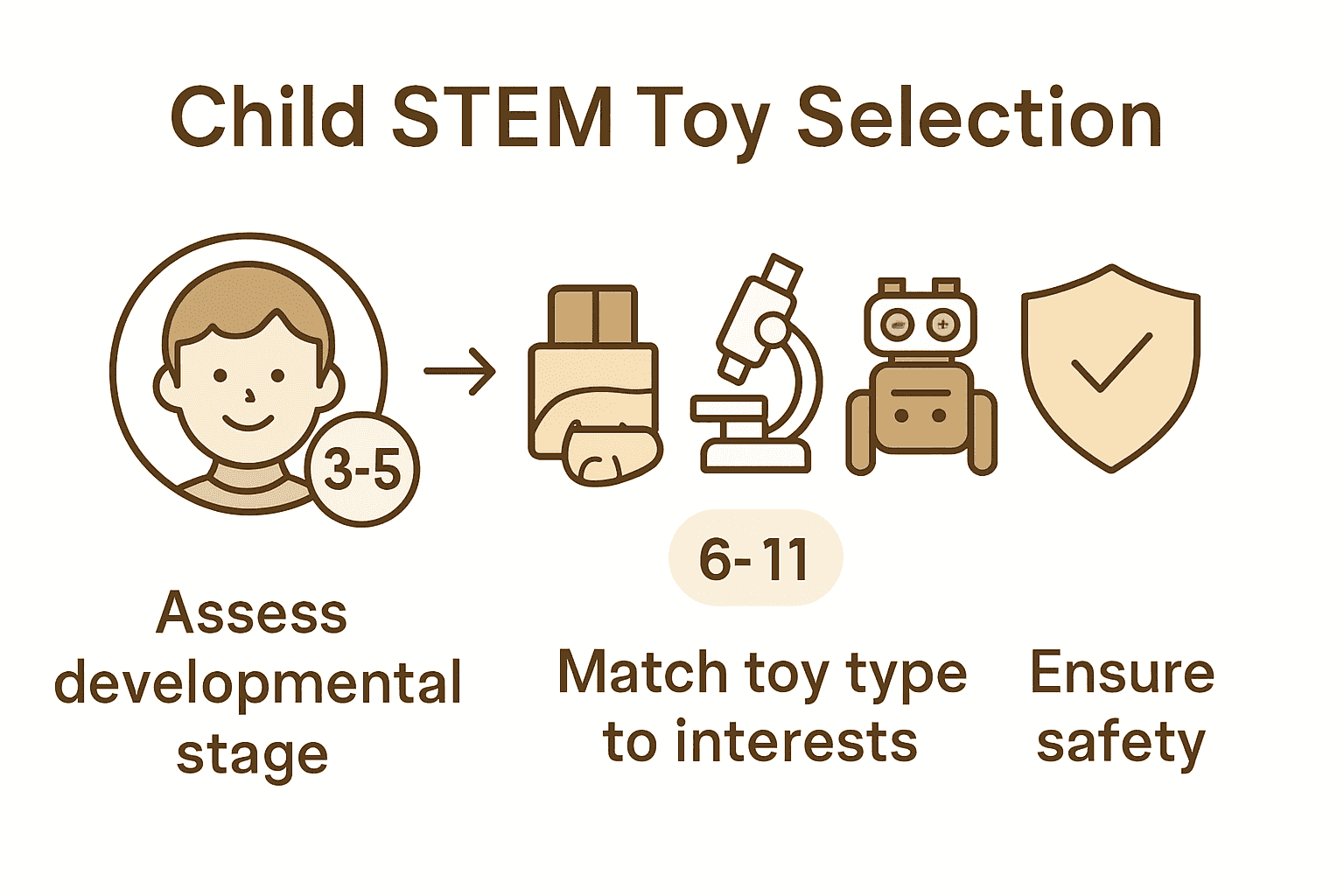
Selecting the right STEM toys requires careful consideration of a child’s developmental stage, interests, and cognitive abilities. Age-appropriate toys are crucial in ensuring that learning experiences are both challenging and enjoyable, creating a perfect balance between stimulation and accessibility for young learners.
For younger children (ages 3-5), STEM toys should focus on basic sensory exploration and simple cause-and-effect interactions. Toddler-friendly STEM toys might include large building blocks, simple puzzles, basic sorting games, and interactive science kits with large, safe components. These toys introduce fundamental concepts like shapes, colours, and basic problem-solving skills while ensuring safety and maintaining engagement through playful design.
As children progress through primary school (ages 6-11), STEM toys become more complex and targeted. This stage allows for more sophisticated engineering sets, coding kits, advanced science experiments, and interactive technology that challenges children to think critically and develop more advanced problem-solving skills. Robotics kits, electronic circuit boards, microscope sets, and programmable devices become increasingly appropriate, matching children’s growing cognitive capabilities and curiosity.
Key considerations when selecting age-appropriate STEM toys include:
- Matching complexity to child’s cognitive development
- Ensuring physical safety of components
- Aligning with the child’s current interests
- Providing progressive learning challenges
- Balancing guided instruction with open-ended exploration
- Encouraging hands-on interaction and experimentation
For comprehensive guidance on selecting the most suitable educational resources, How to Choose Educational Toys for Meaningful Child Growth offers invaluable insights into making informed toy selections that support children’s developmental journey.
Common Pitfalls and Safety Guidelines
Navigating the world of STEM toys requires careful attention to both educational value and potential safety risks. Safety considerations are paramount when selecting and introducing these educational tools, ensuring that children can explore and learn without unnecessary dangers.
One of the most critical pitfalls parents encounter is overlooking age recommendations and complexity levels. Inappropriate toy selection can lead to frustration, potential safety hazards, and diminished learning experiences. Small components pose choking risks for younger children, while overly complex toys can overwhelm and discourage learning. Parents must carefully examine toy packaging, looking for clear age guidelines, potential hazards, and recommended supervision levels.
Electronic and technology-based STEM toys demand extra vigilance. Electronic safety involves multiple considerations, including electrical components, battery management, screen time limitations, and digital security. Parents should inspect toys for sturdy construction, ensure battery compartments are securely sealed, monitor electronic interaction time, and verify that digital components have appropriate child-safety features. Additionally, supervising children’s interactions with technology-based toys helps prevent potential misuse and ensures a safe, educational experience.
Key safety and selection guidelines include:
- Always check age recommendations carefully
- Inspect toys for potential choking hazards
- Ensure electronic components are child-safe
- Supervise complex or technology-based toy interactions
- Verify battery compartment security
- Limit screen time with digital STEM toys
- Clean and sanitise toys regularly
- Store toys safely when not in use
For comprehensive insights into selecting safe and engaging educational resources, Why Age-Appropriate Toys Matter: Complete Guide provides essential guidance for parents navigating the complex world of children’s educational toys.
Discover the Perfect STEM Toys to Spark Your Child’s Curiosity and Growth
Navigating the world of STEM toys can be challenging, especially when aiming to find age-appropriate, safe, and engaging options that truly develop your child’s problem-solving, creativity, and critical thinking skills. As highlighted in our Role of STEM Toys: Complete Guide for UK Families, selecting toys that inspire exploration while matching developmental stages is key to fostering confidence and lifelong learning.

Explore our carefully curated collection of educational toys at Learning Bugs designed to empower young minds through hands-on play. Whether you are looking for construction sets that boost spatial reasoning, interactive science kits, or beginner coding toys, you can find trusted options that meet both safety standards and your child’s curiosity. Start your journey towards meaningful play now by visiting How to Choose Educational Toys for Meaningful Child Growth for expert advice on picking the right developmental tools. Don’t wait to give your child the advantage of joyful, purposeful learning with our standout STEM selections.
Frequently Asked Questions
What are STEM toys?
STEM toys are educational tools designed to teach children about Science, Technology, Engineering, and Mathematics through engaging, hands-on play. They encourage exploration, problem-solving, and critical thinking skills.
How do STEM toys benefit cognitive development in children?
STEM toys enhance cognitive development by challenging children to think analytically, solve problems, and develop complex reasoning skills. They promote critical thinking through interactive experiences such as building and experimenting.
What types of STEM toys are available for different age groups?
STEM toys vary in complexity for different age groups. Younger children (ages 3-5) might enjoy basic building blocks and puzzles, whereas older children (ages 6-11) can tackle more complex engineering sets, coding kits, and advanced science experiments.
What safety considerations should I keep in mind when choosing STEM toys?
When selecting STEM toys, ensure they are age-appropriate, check for choking hazards, supervise interactions with electronic components, and ensure all batteries are secure. It’s essential to regularly clean toys and limit screen time with digital products.
0 comments