





STEM Toys Explained: Boosting Learning Through Play
Discover what STEM toys are with this comprehensive guide. Learn types, benefits, selection tips, UK safety rules, and comparisons with other toys.

In This Guide
Over 80 percent of parents say finding toys that actually help their children learn is a real challenge. With so many options on the market, knowing which toys can spark both curiosity and critical thinking is more important than ever. STEM toys stand out because they blend fun with real learning, giving children a chance to build new skills while they play. Get ready to discover how these clever toys support future scientists, engineers, and creative problem-solvers.
Table of Contents
- What Are STEM Toys And Their Purpose
- Key Categories Of STEM Toys For Children
- Core Benefits Of STEM Toys In Learning
- How To Choose Safe STEM Toys In The UK
- Comparing STEM Toys To Traditional Toys
Key Takeaways
| Point | Details |
|---|---|
| STEM Toys Foster Learning | STEM toys engage children in Science, Technology, Engineering, and Mathematics, promoting problem-solving and critical thinking through play. |
| Diverse Categories Available | STEM toys include construction, scientific exploration, coding, and mathematical reasoning, catering to various interests and developmental stages. |
| Safety and Educational Value Essential | Prioritize age-appropriate design, material safety, and clear learning objectives when selecting STEM toys for children. |
| STEM vs. Traditional Toys | Unlike traditional toys that offer passive play, STEM toys encourage active learning and skill development, enhancing cognitive abilities. |
What Are STEM Toys And Their Purpose
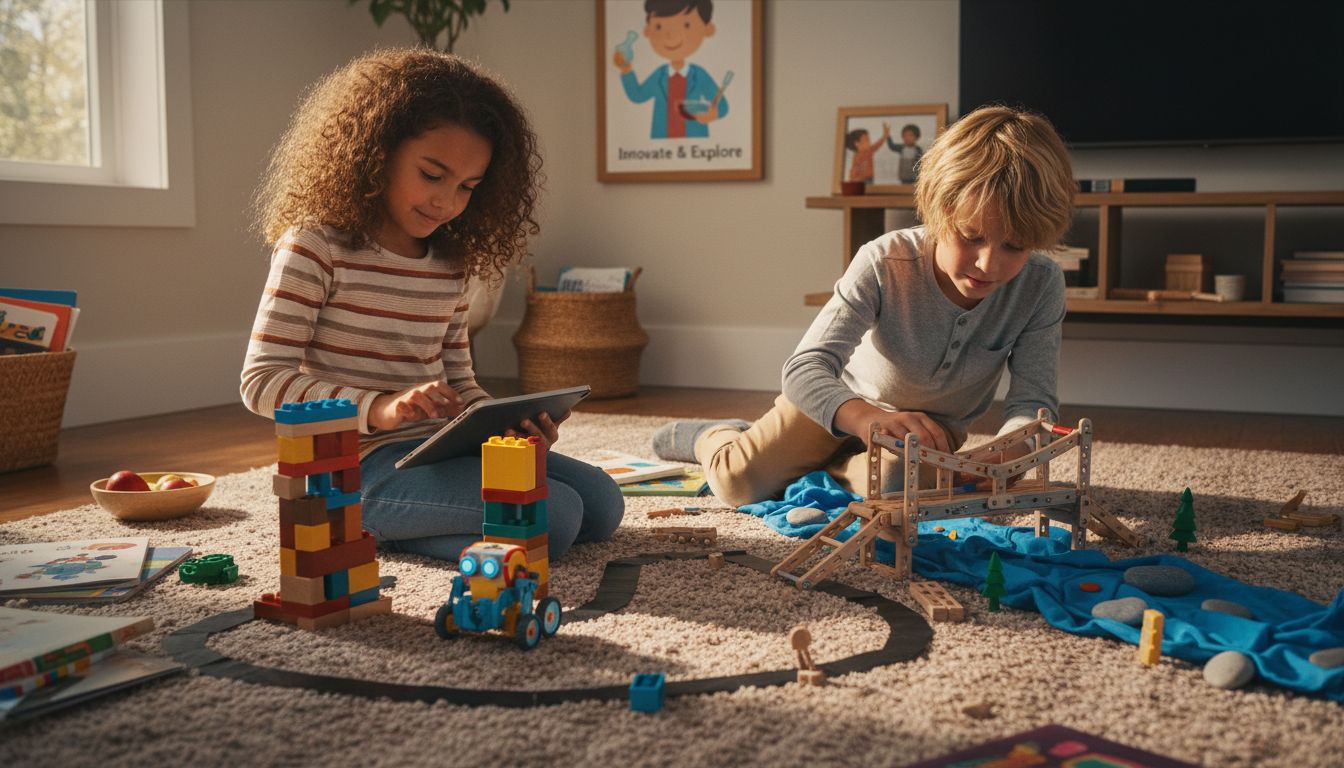
STEM toys are educational playthings specifically designed to engage children in Science, Technology, Engineering, and Mathematics (STEM) learning experiences through interactive and enjoyable play. According to Wondernoggin, these toys help children understand and practice mathematical concepts while promoting logical reasoning and introducing advanced topics like geometry and algebra.
These remarkable learning tools transform complex educational concepts into engaging, hands-on experiences. By combining play with learning, STEM toys encourage children to develop critical skills such as problem-solving, analytical thinking, and creative exploration. They typically feature elements that challenge young minds to experiment, build, design, and discover - whether through coding kits, construction sets, mathematical puzzles, or scientific exploration tools.
Key characteristics of STEM toys include:
- Interactive learning experiences
- Focus on practical skill development
- Encouragement of curiosity and experimentation
- Age-appropriate complexity
- Promotion of independent thinking
Parents seeking educational resources can explore Understanding Why Choose Educational Toys to gain deeper insights into selecting the most appropriate learning tools for their children’s developmental stages. STEM toys represent more than just playthings - they are gateways to future learning, inspiring children to approach challenges with creativity, logic, and enthusiasm.
Key Categories Of STEM Toys For Children
STEM toys span multiple exciting categories designed to spark curiosity and develop critical learning skills across different developmental domains. Understanding these categories helps parents select the most appropriate learning tools for their children’s unique interests and educational needs.
The primary STEM toy categories include:
- Construction and Engineering Toys
- Building blocks and construction sets
- Mechanical engineering kits
- Robotics assembly sets
- Architectural design platforms
- Scientific Exploration Toys
- Microscope and telescope sets
- Chemistry experiment kits
- Nature exploration tools
- Weather monitoring devices
- Coding and Technology Toys
- Programmable robot kits
- Basic coding learning platforms
- Electronic circuit building sets
- Computer programming starter kits
- Mathematical Reasoning Toys
- Puzzle and logic games
- Geometry and spatial reasoning sets
- Mathematical manipulation tools
- Pattern recognition games
Parents seeking more comprehensive guidance on selecting educational toys can explore our 6 Types of Educational Toys to Boost Learning Fun guide. Each STEM toy category offers unique opportunities for children to develop problem-solving skills, logical thinking, and creative exploration through engaging play experiences.
By introducing children to these diverse STEM toy categories, parents can nurture a lifelong love of learning, encouraging young minds to approach challenges with curiosity, analytical thinking, and enthusiasm. The key is selecting age-appropriate toys that match a child’s developmental stage and individual interests.
Core Benefits Of STEM Toys In Learning
STEM toys are powerful educational tools that deliver far more than simple entertainment. These innovative learning resources provide children with critical developmental advantages that extend well beyond traditional play experiences. By engaging with STEM toys, children develop essential skills that form the foundation of lifelong learning and intellectual growth.
The core benefits of STEM toys include:
-
Cognitive Skill Development
- Enhanced problem-solving abilities
- Improved critical thinking skills
- Increased logical reasoning capabilities
- Better spatial awareness and mental manipulation
-
Technical Skill Acquisition
- Introduction to basic programming concepts
- Understanding of mechanical and engineering principles
- Early exposure to technological interfaces
- Development of computational thinking
-
Emotional and Social Learning
- Building confidence through independent exploration
- Learning persistence and resilience
- Practicing collaborative problem-solving
- Developing creativity and innovative thinking
Parents interested in understanding the deeper impact of educational play can explore our comprehensive Why Invest in Educational Toys guide. These toys are not just playthings - they are carefully designed learning instruments that transform complex concepts into engaging, accessible experiences.
By integrating STEM toys into children’s play routines, parents can nurture a generation of curious, analytical, and adaptable learners. The magic lies in making education feel like an adventure, where learning becomes a natural, enjoyable process that children eagerly embrace. Each interaction with a STEM toy is an opportunity for growth, discovery, and the development of skills that will serve children throughout their academic and professional lives.
How To Choose Safe STEM Toys In The UK
Choosing the right STEM toys requires careful consideration of safety, educational value, and developmental appropriateness. According to Wondernoggin, selecting toys that reinforce basic concepts can make learning enjoyable and help remove any fear or apprehension associated with complex subjects like mathematics and science.
Key safety and selection criteria for STEM toys include:
- Age Appropriateness
- Check recommended age ranges
- Ensure complexity matches child’s developmental stage
- Avoid toys with small parts for younger children
- Select toys that challenge but do not overwhelm
- Material Safety
- Choose non-toxic materials
- Look for CE marking (European safety certification)
- Verify BPA-free and lead-free components
- Check for smooth edges and robust construction
- Educational Quality
- Select toys with clear learning objectives
- Ensure interactive and engaging design
- Look for toys that promote hands-on exploration
- Prioritize toys that develop multiple skills simultaneously
Parents seeking comprehensive guidance on selecting educational toys can refer to our Why Age-Appropriate Toys Matter guide. Understanding these selection criteria helps ensure that STEM toys are not just safe, but also meaningful tools for childhood learning and development.
Remember, the best STEM toys transform complex concepts into exciting, accessible experiences. By prioritising safety, educational value, and age-appropriate design, parents can provide children with powerful learning tools that spark curiosity, build confidence, and make education an adventure.
Comparing STEM Toys To Traditional Toys
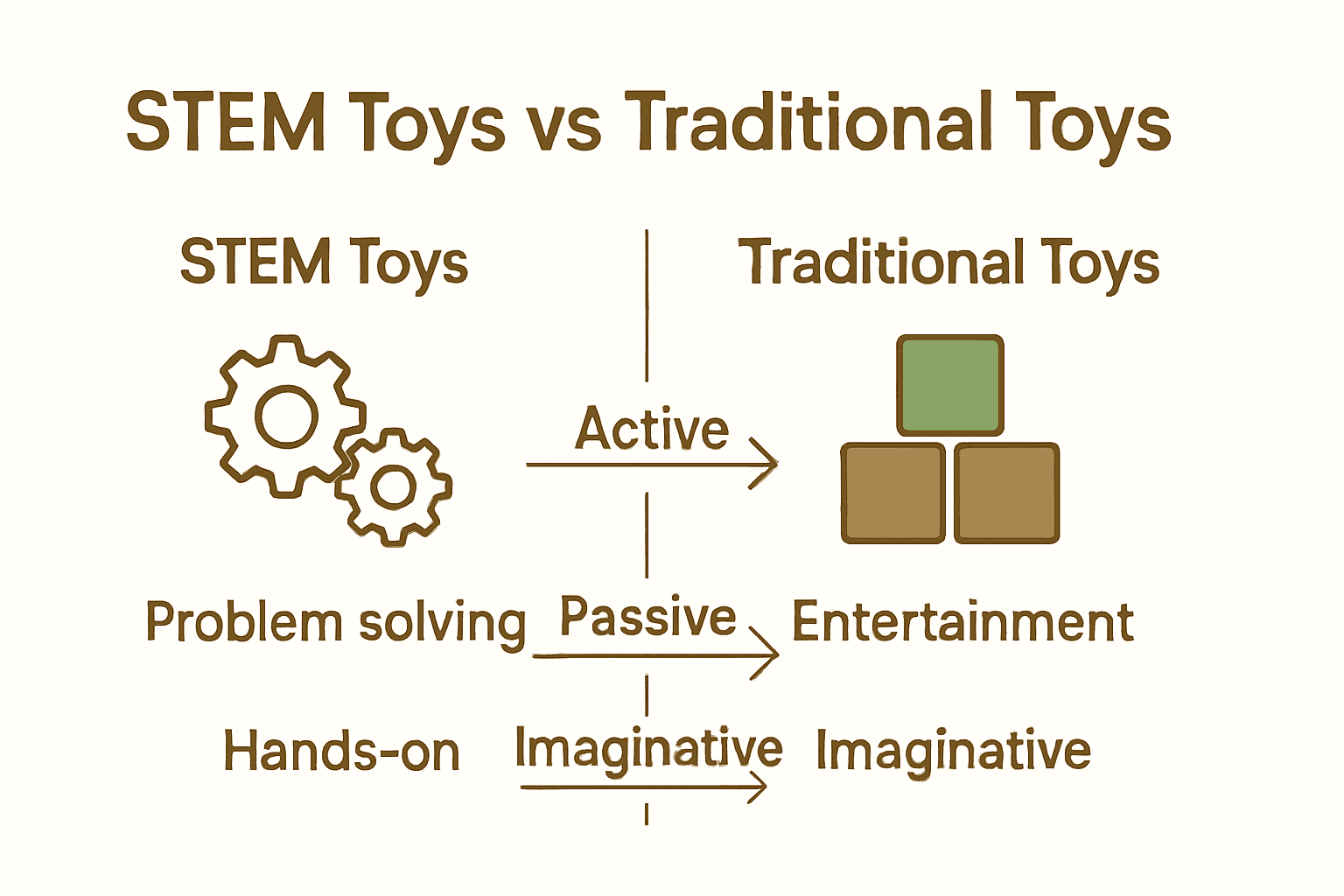
STEM toys represent a significant evolution in children’s play, offering a more intentional and developmental approach compared to traditional toys. While classic toys focus primarily on entertainment, STEM toys are designed to actively engage children’s cognitive abilities, problem-solving skills, and critical thinking capabilities.
Key differences between STEM and traditional toys include:
Learning Approach
-
Traditional Toys
- Passive entertainment
- Limited skill development
- Primarily focused on imaginative play
- Less structured learning experience
-
STEM Toys
- Active learning and exploration
- Deliberate skill-building
- Combines play with educational objectives
- Structured yet engaging learning experience
Skill Development
-
Traditional Toys
- Fine motor skill enhancement
- Basic creativity and imagination
- Social interaction
- Emotional expression
-
STEM Toys
- Advanced problem-solving skills
- Logical and computational thinking
- Technical skill introduction
- Scientific reasoning and analytical capabilities
Parents looking to understand the broader impact of educational play can explore our Understanding Why Educational Toys Matter guide. The fundamental difference lies not in replacing traditional play, but in complementing it with more purposeful, skill-building experiences.
Ultimately, both traditional and STEM toys have their place in a child’s development. The key is creating a balanced play environment that nurtures creativity, curiosity, and learning through diverse, engaging experiences. STEM toys do not compete with traditional toys - they expand the landscape of play, transforming learning into an exciting, interactive journey.
Transform Your Child’s Learning Journey with Thoughtful STEM Toys
Many parents recognise the challenge of finding toys that do more than just entertain. As highlighted in the article, STEM toys offer a practical way to nurture critical skills such as problem-solving, logical thinking, and creativity early on. Yet choosing safe, age-appropriate toys that effectively support learning can feel overwhelming. This is why discovering carefully curated options that blend educational value with engaging play is essential to spark your child’s curiosity and confidence.
Experience the benefits of purposeful play today by exploring a wide selection of high-quality educational kits and creative toys at Learning Bugs. Our collections are thoughtfully organised to help you find the perfect STEM toys designed to develop essential skills while making learning feel like an exciting adventure. Start nurturing your child’s potential now and take the first step towards making education a joyful part of everyday play. Visit Learning Bugs to browse our range and find inspiring toys that grow with your child.
Frequently Asked Questions
What are STEM toys?
STEM toys are educational playthings designed to engage children in learning experiences related to Science, Technology, Engineering, and Mathematics through interactive play.
How do STEM toys benefit children’s learning?
STEM toys enhance cognitive skills, technical abilities, and social-emotional development by promoting problem-solving, critical thinking, and collaborative exploration through play.
What types of skills do STEM toys help develop?
STEM toys help develop advanced problem-solving abilities, logical thinking, understanding of engineering principles, creativity, and emotional resilience through engaging and hands-on experiences.
How can I choose safe STEM toys for my child?
To choose safe STEM toys, check for age appropriateness, ensure they are made from non-toxic materials, look for educational quality, and verify that they have robust construction and safety certifications.
Recommended
- Understanding Why Choose Educational Toys for Children – Learning Bugs
- Understanding Why Educational Toys Matter for Children – Learning Bugs
- The Essential Guide to the Role of Educational Toys – Learning Bugs
- Why Invest in Educational Toys: Complete Guide – Learning Bugs
- Top Children’s Emotional Intelligence Books 2025